Marco Polo’s paid community product for women seeking platonic connection. I led brand design for the new product and learned to code so I could ship and maintain the website and funnel experience myself.
The problem
Marco Polo has been around for over a decade. People love it. It’s also not much use if you don’t have anyone to talk to.
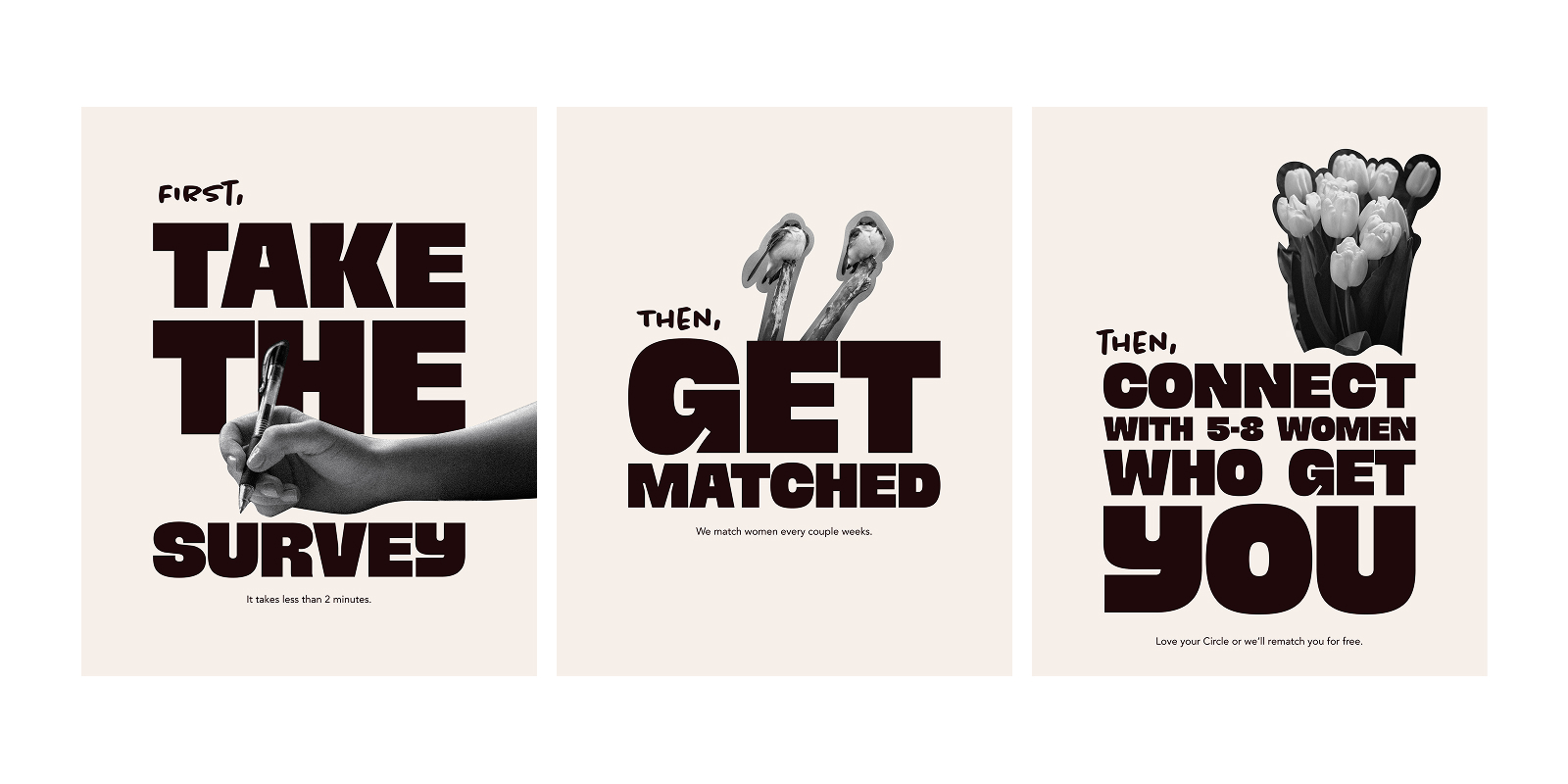
Circles was our answer to that: small groups of women, matched on shared interests and life stage, talking over async video for a few weeks. A paid product, $75, for something most people have never tried and can’t really picture.
Which meant we knew almost nothing. Not the price, not who it was for, not what would make someone actually buy. We had to find out, and we had to do it fast.
The engine
Before this project I didn’t know how to code at all.
I worked with an engineer who taught me architecture, and we built the Circles site and the funnel system behind it. Landing pages that match specific Meta ads and campaigns. A/B tests I can set up, ship, and read myself. Data coming back while a test is still running, so we can adjust on the fly.
The whole point is speed. A growth team moves as fast as it can get a variant live, and that’s usually days. Design it, hand it off, wait, ship it, wait again. When the person designing the funnel can also ship it and read the results, the loop collapses from days to minutes.
Everything else in this case study happened because that existed.
What we found
So we tested everything. Price. Survey length. Local matching versus national. The money-back guarantee. [X] variants over [Y] months, each one a real question with a real answer at the end of it.
Here’s the one I like best.
Circles offered a money-back guarantee, and it was doing a real job. At $75, for a product whose value is unfamiliar and social, it lowers the cost of trying. But the language was open-ended enough that the business couldn’t recognize the revenue. The question was never whether to keep it. It was whether we could make it airtight without losing the reassurance that made it work.
- Hypothesis
- The guarantee converts by removing the fear of being stuck, not by its generosity. Tightening the terms shouldn’t move conversion.
- Test
- Fourteen days, survey start through purchase, kill criteria set before it started.
- Result
- Treatment held within about a point of control. Tightening the terms cost us nothing at the point of sale.
The guarantee was never selling generosity. It was selling permission to try. Once that was clear the terms became negotiable and the reassurance could stay. It shipped as “Love your Circle or we’ll rematch you for free.”
We ran tests like that until the product stopped being a guess. By the time we were ready to launch, we knew what Circles cost, who it was for, and what someone needed to hear before they’d try it.
The debt
There was a bill for all that speed.
Every test had invented its own fonts and its own color scheme. Ads didn’t match the pages they led to. What we’d built was a Frankenstein web of optimizations, each one locally correct and none of them related to each other. It was a mess born out of necessity, but the debt was catching up with us.
The brand wasn’t compounding. Because no two tests looked alike, we were paying to introduce ourselves over and over to the same audience. Someone could click an ad, land on a page that looked like a different company, and then decide whether to hand that company $75 and the next several weeks of their life.
We weren’t just announcing a new product. We were building a path to trust.
The rebrand
So I rebranded it.
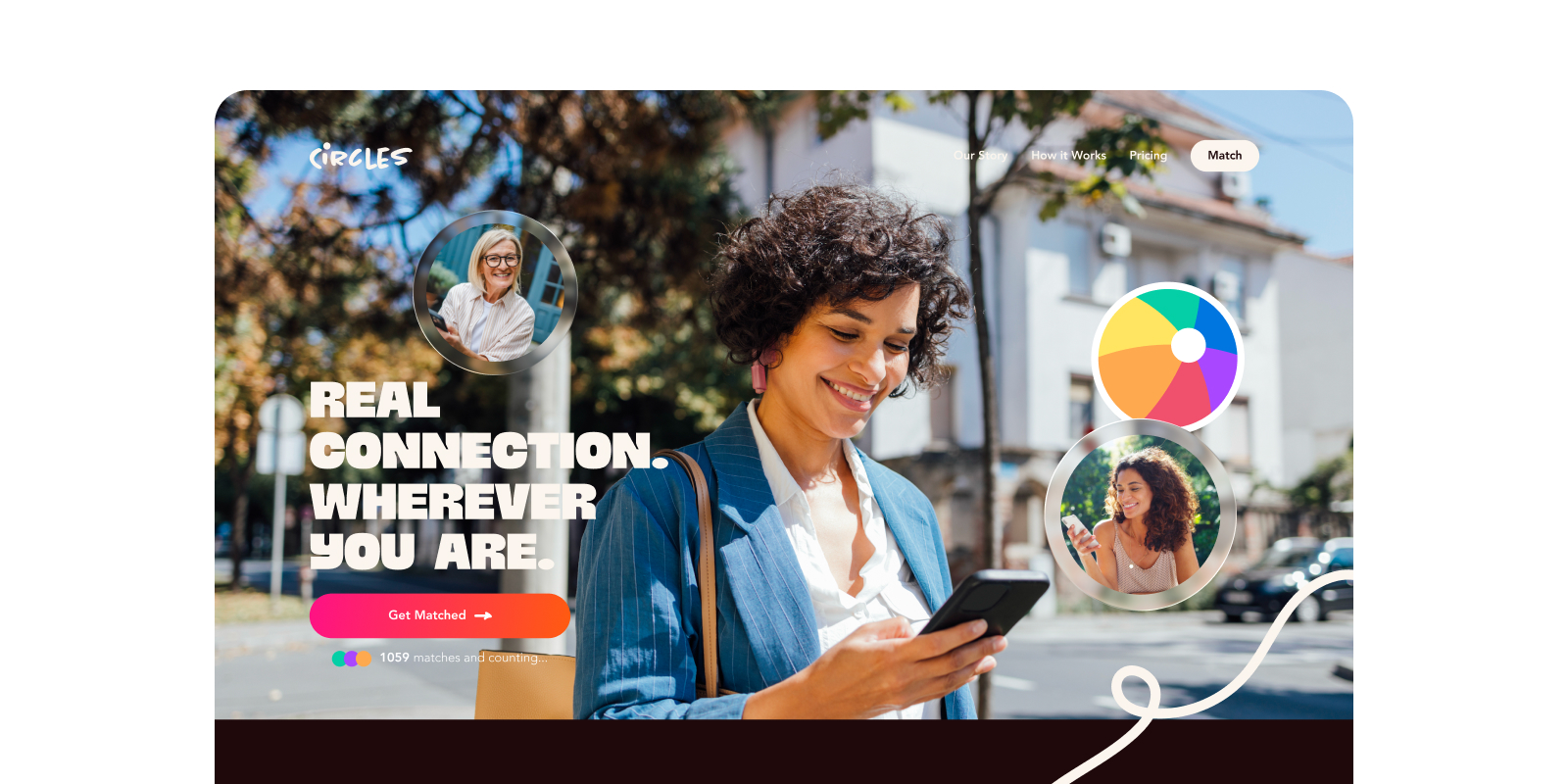
I wanted something glossy. Something that made Circles look like a product you’d want, not a test that got out of hand.
Wordmark. Rounded, hand-drawn letterforms set in a warm gradient pulled from Marco Polo’s existing brand DNA, but distinct enough that Circles reads as its own product inside a bigger family.
Voice. “When did making friends get so hard? We fixed that.” It states the pain in the user’s own words and answers it in four. Adult loneliness is easy to make saccharine. The tone had to be warm and a little funny instead, or it reads as pity.
Casting. The photography is women in their fifties and sixties, on their own, in ordinary places. Not twenty-somethings laughing over brunch. For a product about adult friendship, who you picture is the positioning.
Then I tested
my own brand
Three-way live funnel test, the new brand against the thing it was built to replace.
The result was uncomfortable. Anecdotally everybody loved it, people told us it looked great. But against cold paid traffic it converted noticeably worse than the Frankenstein. Against organic and direct it held up, and in places it beat the baseline.
Both easy reads were wrong. Killing it ignores that it was built to fix a real, expensive problem. Launching it everywhere ignores the data.
What the numbers were showing was a segmentation finding. Someone who clicks an ad mid-scroll arrives with no context and needs the offer stated immediately. Someone who arrives through search, or social, or a friend, is already curious, and brand is what turns curiosity into trust.
Shipping a brand everywhere on conviction, with the numbers standing in direct opposition, would have been a recipe for failure.
So we shipped both
We launched in September with the new brand on everything forward-facing, and kept the highest-converting funnel running underneath, served only to people arriving from an ad. Organic gets the brand. Paid gets what paid responds to.
That’s only possible because of what we built at the start. The same infrastructure that let us run all those tests is what lets us serve two different front doors without maintaining two different products.
Best of both worlds. Hannah Montana.